Obsessive | Compulsive
Group Exhibition
Curated by Eric Butcher
December 17, 2025, to February 14, 2026
Exhibition Reception
5pm to 7pm
Saturday, January 10
NANCY TOOMEY FINE ART
1275 Minnesota Street, San Francisco
Nancy Toomey Fine Art is pleased to announce a group exhibition titled Obsessive | Compulsive on view from December 17, 2025, to February 14, 2026, curated by Eric Butcher with works by Larry Bell, Lucinda Burgess, Eric Butcher, Morrissey & Hancock, Andy Harper, Sam Hodge, Barbara Nicholls, Matthew Picton, Diogo Pimentão, Gregg Renfrow, Giulia Ricci, Michael Russell, Carole Silverstein, and Suzan Woodruff.
The gallery is located inside San Francisco’s Minnesota Street Project, 1275 Minnesota Street. Gallery hours are Tuesday through Saturday, 12pm to 4pm, and by appointment–please contact nancy@nancytoomeyfineart.com or 415-307-9038.

Eric Butcher, G/R. 1109, 2025, recycled paint fragments: acrylic, graphite, tin + acrylic gel on paper, 15 x 11 inches
Obsessive | Compulsive, curated by UK-based artist Eric Butcher at Nancy Toomey Fine Art in San Francisco, is an exhibition of works which are clearly and visibly a result of the processes of their creation. A preoccupation with systems, procedures, and processes allows each of the artists to end up in a place unplanned and unimagined. They share a preoccupation with the materiality of their medium, a delight in the physical properties of the material, and the dialogue between chance and control.

Eric Butcher
“The show comprises six US artists and eight UK artists,” says artist and curator Eric Butcher. “As part of my commitment to sustainability, the UK artists were asked to submit unframed works on paper or unstretched canvas, which were rolled-up together in two cardboard tubes. Lightweight and highly compact, the carbon cost of shipping was minimized, while the inclusion of the US artists means the show has a wider range of physical manifestations and isn’t just a show of unframed works on paper.”

Larry Bell, AAAAA 57, 2007, mixed media on black Hiromi paper in artist’s frame, 42.75 x 32.25 inches (framed)
Larry Bell (born 1939), based in Taos, New Mexico, and Venice, California, is a leading figure of the California Light and Space movement. Bell’s AAAAA 57 (2007) is a mixed media collage from his Vapor Drawings body of work and forms part of the broader AAAAA series. He created these works on paper using a specialized vacuum deposition process, often incorporating materials such as aluminum and silicon monoxide applied to black Hiromi paper. Characterized by an intuitive and improvisational process, the AAAAA works investigate light and perception through surfaces that reflect, absorb, and transmit light, generating subtle illusions of depth, movement, and spatial ambiguity. His work is exhibited and in the permanent collections of numerous national and international museums, galleries, foundations, and private collections including the Tate Modern, London, the Carre d’art, Nimes, the Museum of Modern Art, NY, the Whitney Museum of American Art, NY, the Museum of Contemporary Art, LA, and many others.

Lucinda Burgess, Red Fugue, 2025, Indian Khadi paper, pigment, wax and pencil, 27.5 h x 27.5 d (approx.) inches, dimensions variable
Lucinda Burgess is a British artist living and working in the UK, known for her conceptual drawing and installation. Burgess’s primary focus is on materiality–she is particularly drawn to its natural, often delicate and always changeable character. Materials are presented in their manufactured but unadorned state–minimally and simply. It could be steel, paper, graphite, glass, wood, or wax polish. The work is primarily about the changeability of these materials, especially about the changeability of the viewer’s visual field as they move around the piece. Having spent over a decade studying and meditating in a Buddhist monastery, Burgess places great emphasis on the first-hand direct experience of the viewer. She contrasts our ideas of fixed things existing in an objective world with the actual experience of relentless change. To this end Burgess often uses reflective materials which enhance the changeability of the visual field. She studied Fine Art at Edinburgh College of Art, Bath Academy of Art, and Goldsmiths, University of London. Burgess is also the 2024 winner of Royal West of England Academy Drawing Prize.

Eric Butcher, G/R. 1104, 1105, 1106, 1107, 1108, 1109, 1110, 1111, 112, 2025, recycled paint fragments: acrylic, graphite, tin + acrylic gel on paper, 15 x 11 inches (each), 47 x 35 inches (all)
UK-based artist Eric Butcher creates work by destroying his own paintings, peeling the paint from its original support and reconfiguring it between sheets of glass or on paper, producing a “natural history” of his past creative endeavors. Driven by environmental and existential concerns, he works exclusively with materials already in his studio, repurposing and recycling without consuming more, and will cease making art once all available materials are used. Born in Singapore in 1970, Butcher studied Philosophy at Cambridge University and Painting at Wimbledon School of Art, and has exhibited widely in the UK and internationally, including Austria, Germany, Italy, Switzerland, Australia, and the USA. His work has been shortlisted for multiple drawing and painting prizes, and in 2025 he received the Royal West of England Academy Award and the Evelyn Williams Drawing Award; his work is held in public and private collections worldwide.

Morrissey & Hancock, Rotational Series, 2025, ink and acrylic on paper, 46.8 x 33.1 inches
Morrissey and Hancock (Patrick Morrissey, Hanz Hancock), based in the UK, have evolved a close working relationship over the last twenty or so years, focussing increasingly on the idea of a “third voice” whereby they shelve ego in the production of their creative output. Morrissey’s systems based practice has combined with Hancock’s predisposition towards geometry and especially drawing, resulting in a collaborative process which has enabled a free flow of conceptualization. In addition to their personal creative output, they have established the online editorial and physical project space in London, Saturation Point projects. In this space they promote the work of systems, non objective art and artists in their salon program, as well as their online platform of the same name which presents and remains a general overview of these genres as well as critical essays, reviews, and so forth.

Andy Harper, Choreomaniacs, 2009, oil on linen, 19.75 x 15.75 inches
Rendered with extreme detail and a charged sense of both reality and fantasy, Andy Harper’s paintings operate as arenas of discovery, where flashes of light, vegetal forms, human anatomy, and ivory-toned bone evoke the exuberance of growth alongside its inevitable counterpart–decay. His worlds feel at once familiar and imagined, suspenseful yet intimate, revealing life in a continual state of becoming. Whether working from invented botanical scenes, abstraction, or appropriated imagery, Harper employs a consistent wet-on-wet technique, spreading transparent layers of paint across a slippery surface and manipulating them with brushes and tools within a fleeting window of time. Born in the UK in 1971, Harper lives in Cornwall and has exhibited widely across Europe and internationally, with solo exhibitions including Page Gallery, Seoul, and Morgen Contemporary, Berlin.

Sam Hodge, Unfolding series grid (various titles), 2025, relief print from unfolded cardboard packaging in ink made with natural pigments (various) on gray paper, 15 x 11 inches (each), 47 x 35 inches (all)
The Unfolding series began around five years ago, when Sam Hodge started making her own pigments and collecting unfolded cardboard boxes, combining these practices into an ongoing body of prints shaped by the variety of box forms and natural ochre colors. Using inks made from earths gathered along the coast of England, she prints the cardboard through an etching press in layered impressions that create ambiguous, open-ended forms. Sourced largely from her own recycling and from rocks collected during an ongoing walk of the English and Welsh coastline, the works contrast the ephemerality of packaging with deep geological time, reflecting on human consumption and impact in the Anthropocene. Hodge (born 1963) is a UK-based artist whose practice explores material transformation across timescales; formerly a painting conservator, including at Tate, she has exhibited widely, with works held in collections such as The Met, MoMA, and the SAIC Joan Flash Artist’s Book Collection.

Barbara Nicholls, Amalgam No. 11, 2013, watercolour on Saunders Waterford 638gsm HP, 60 x 40 inches
Known for her monumental watercolors, London-based Barbara Nicholls manipulates pigment in increasingly large volumes of water, extending a wider practice that has involved stitching, drawing, cutting, and extracting materials from archaeological, architectural, and geological sites. Her works evoke collective memories of landscape–ancient pathways, waterways, tide marks, sediment layers, and shifting geological forms–without fixing on specific identities, creating what critic Martin Holman describes as “a new reality.” Nicholls (born 1963) has exhibited widely and internationally, including at Norwich Castle Museum, Museum Kurhaus Kleve (Germany), Patrick Heide Contemporary Art, and institutions across Europe and Australia, and has undertaken numerous residencies such as the Nordic Watercolour Museum (Sweden) and Stiftung Insel Hombroich (Germany). A recipient of Arts Council England and British Council grants, her work is held in public collections including Museum Kurhaus Kleve and The New Art Gallery Walsall, as well as private collections internationally.

Matthew Picton, Roma #1, 2025, archival digital photographs, Yupo paper, pins, 52 x 39 inches
Inspired by Federico Fellini’s film Roma, Matthew Picton’s Roma #2 presents the city as a layered protagonist, weaving together myth, history, and cinematic memory, from the founding legend of Romulus and Remus to the buried frescoes revealed during modern subway construction. The work combines drawings of Vatican tomb alcoves–featuring Pope Urban VIII flanked by allegorical figures–with cut film posters and stills from Fellini’s film, including the she-wolf emblem visible in the lower portion. This approach reflects Picton’s broader practice of meticulously hand-cut, mixed-media works that trace the rise and decline of cities, empires, and power structures by layering political, architectural, and historical references. Trained in politics and history at the London School of Economics, Picton has been a full-time artist since 1996, exhibiting widely in the US and Europe, with works in major museum and corporate collections. He lives and works in Ashland, Oregon.

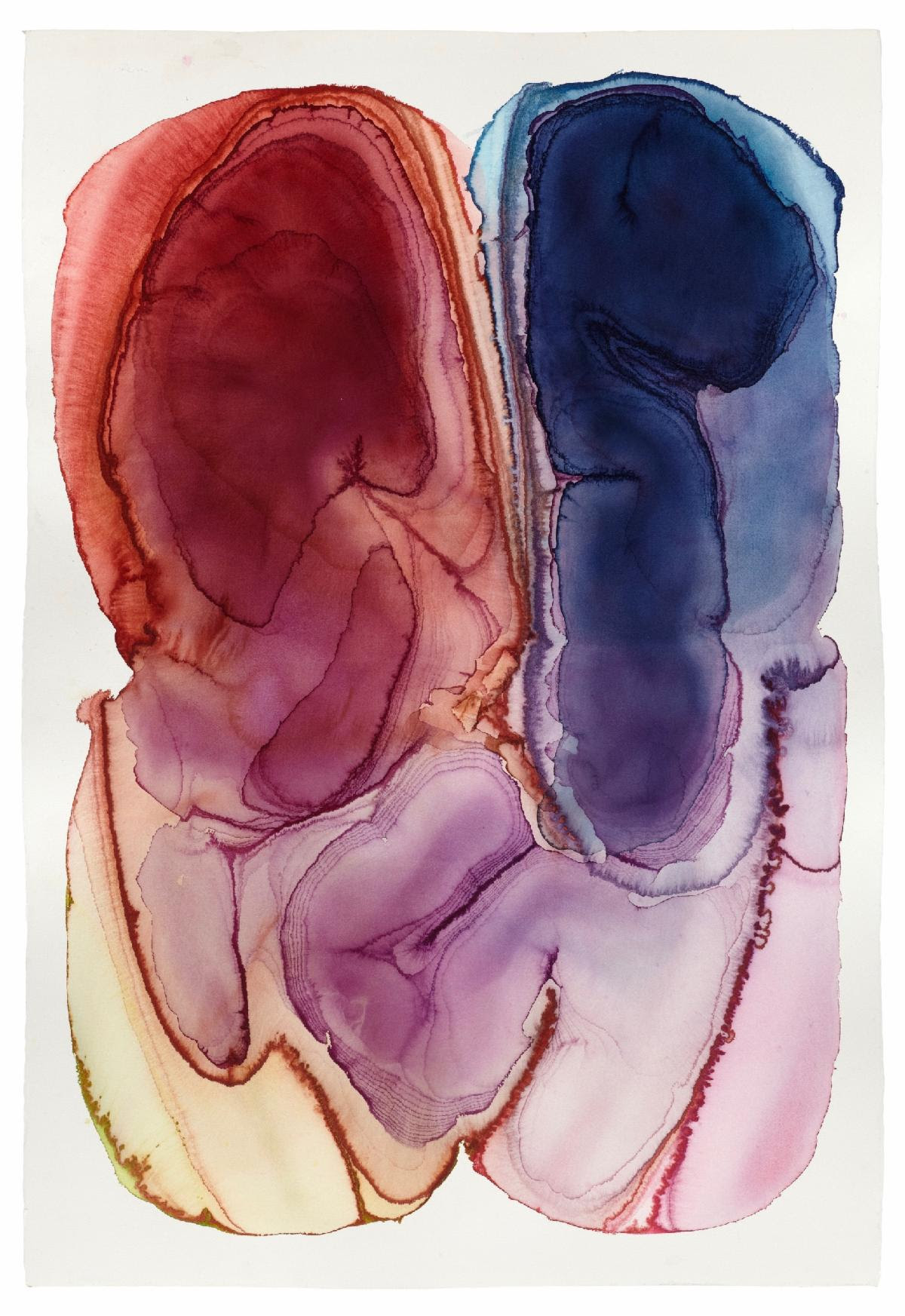
Diogo Pimentão, Tears for Action (Reciprocity), 2025, pigment on paper, 37 x 27.5 inches
Diogo Pimentão (born Lisbon, 1973) lives and works in London and is known for experimental, drawing-based works that blur the boundaries between drawing and sculpture through an intensive engagement with materiality. Working primarily with paper and graphite–and at times incorporating concrete, video, and performance–Pimentão employs processes such as “blind drawing,” coating sheets with freely moving graphite particles that are folded and layered into structures that defy the perceived lightness of paper, often resembling welded metal and engaging directly with architectural space. His labor-intensive methods, aligned with post-Minimalist concerns yet deceptive in their apparent simplicity, foreground the memory, history, and concealed aspects of materials, producing works that challenge perceptions of depth, weight, and form. In a recent series, Pimentão transforms the syringe–an object drawn from childhood memories of a medical environment–into a drawing tool, injecting water and restrained primary colors into paper to create delicate fields of tension that oscillate between the clinical and the intimate. He studied at ArCo in Lisbon, in Gotland, and at the Centro Internacional de Escultura in Pêro Pinheiro, and his work is held in international private and institutional collections across Europe, the United States, Asia, and Australia.

Gregg Renfrow, Turner’s Solstice, 2025, polymer, pigment on cast acrylic, 48 x 48 inches
Gregg Renfrow, based in the San Francisco Bay Area, works on acrylic panels that allow light to filter through the pigment. The result is an illumination of color and form subtly projected from the surface of the work. While looking at this painting, the bands of color may appear suspended in real time and space. Renfrow achieves this discoloration, or dematerialization of the painted image, by pouring polymer over acrylic panels. He is very careful not to interrupt the runs of paint with the unpredictable effects of the human hand. The impression from the contact of carefully applied pigment and transparent support is that the process has occurred by itself through some unknown power or force. Gregg Renfrow received his BFA from San Francisco Art Institute and has exhibited both nationally and internationally since the mid-1970s. Renfrow lives and works in the SF Bay Area. His work is included in numerous private and public collections, including the San Francisco Museum of Modern Art, Oakland Museum, and Weisman Collection in Los Angeles.

Giulia Ricci, Untitled Painting VIII, 2024, acrylic paint and pencil on canvas, wooden batten, 46.25 x 39.5 inches
Untitled Painting is a series of acrylic works on canvas in which Giulia Ricci brings the flat, repeated structures of her drawings into dialogue with the material and physical presence of painting, deliberately referencing textile artefacts such as banners and wall hangings rather than traditional stretched canvases. Hung from a batten and allowed to unroll freely, the canvases respond to gravity and environmental conditions, while sharply masked, straight-from-the-tube colors and hand-applied paint create precise yet tactile surfaces in which figure and ground remain interchangeable. Building on her established language of grids and repeated triangles—rooted in weaving, tiling, and architectural structures—the works explore interconnectedness and how small shifts in orientation produce unexpected structural effects. Lightweight, portable, and economical in materials, the paintings are designed to be rolled, transported, and reinstalled with ease. Ricci (born Bagnacavallo, Italy, 1976) has lived and worked in London since 2004. Trained in painting, art history, and sculpture, she has exhibited internationally and completed numerous public and private commissions, alongside her research into the materiality of drawing.

Michael Russell, Untitled 25, 2015, graphite on paper, 31.25 x 30.25 inches (framed)
Los Angeles-based artist Michael Russell explores the passage of time through drawing, using linear, repetitive mark-making as a record of duration and an invitation to introspection for both artist and viewer. His works reveal the intimacy of process rather than the evidence of labor, as rhythm accumulates into a quiet stillness through carefully engineered compositions built from modest, rudimentary techniques rather than sweeping gestures. Born in Los Angeles in 1985, Russell earned a BFA from UCLA in 2012 and an MFA from Claremont Graduate University in 2015, and has exhibited widely in Los Angeles venues including Santa Monica Prefecture, Malibu Circa 1990, and Control Room. His work has also been published by New American Paintings and the Hammer Museum’s Graphite Interdisciplinary Journal of the Arts.

Carole Silverstein, the thread of longing & repair, 2023, acrylic ink on mylar, custom framed on white aluminum, 48.5 x 36.5 inches (framed)
Carole Silverstein’s the thread of longing & repair centers on a recurring cosmic web motif drawn from sacred geometry, extending her long-standing garden imagery as a metaphor for healing, rupture, and renewal. Guided by the Buddhist and Hindu concept of Indra’s Net—an infinitely interdependent universe—and the Jewish idea of tikkun olam, or repairing a broken world, her paintings and watercolors explore re-weaving wholeness on both personal and collective levels. Silverstein is a Los Angeles-based artist with an MFA from Queens College CUNY and a BFA from the School of the Art Institute of Chicago. Her work has been exhibited internationally, featured in a collateral exhibition of the 2015 Venice Biennale, and is held in major public and private collections including LACMA and Art in US Embassies.

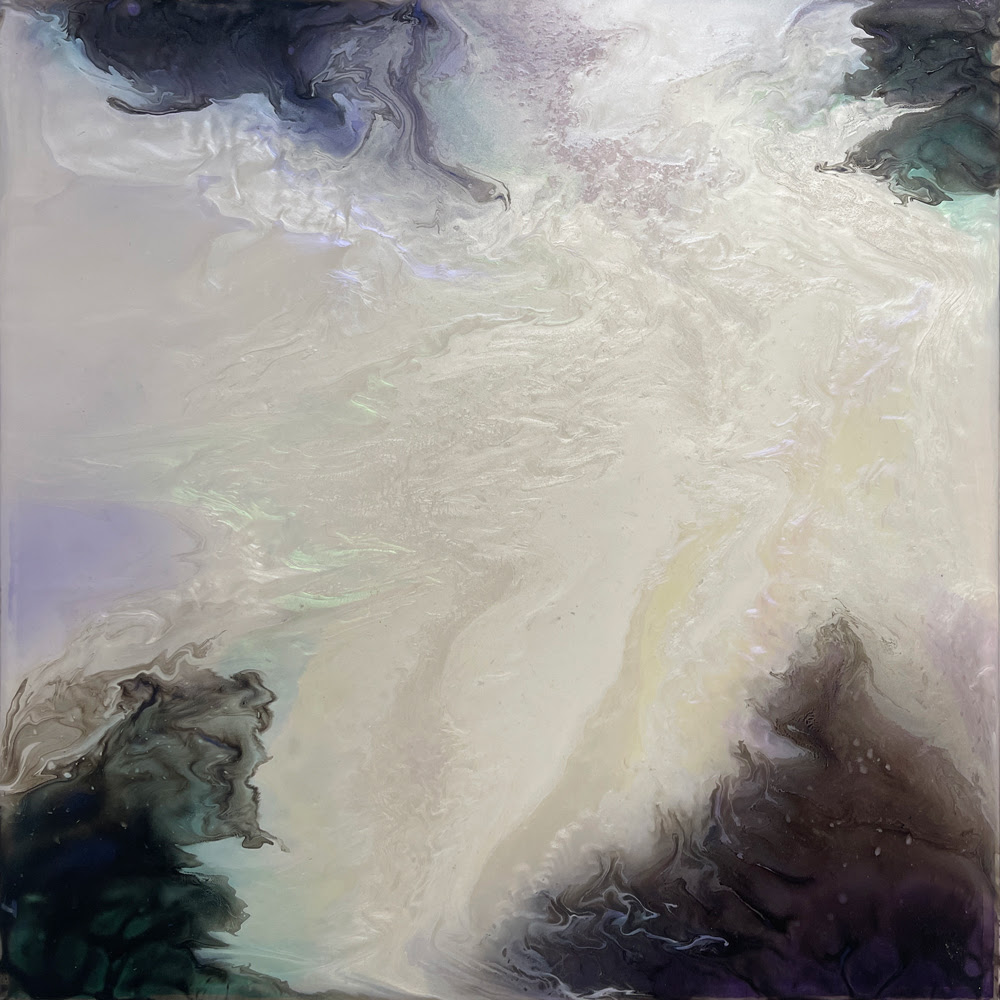
Suzan Woodruff, Swirling Pearl, 2025, acrylic on acrylic, 24 x 24 inches
With a method of controlled chaos, Los Angeles-based Suzan Woodruff paints works that depict natural occurrences, from the molecular to interstellar phenomena. Using gravity, pigment, viscosity and evaporation, she re-creates nature within her ethereal acrylic color explorations. The iridescent shimmering surfaces are a result of her studio practice; a rigorous physical process involving constant motion that keeps her open to the “visitations and apparitions” that inform the end result. The work can resemble patterns of the earth as seen from space, or the smallest cosmic eruption at the cellular level. Woodruff is a recipient of numerous awards and residencies, and her work is included in numerous private and public collections around the world. Woodruff has been reviewed and featured in Art Ltd, Budapest Sun, Artweek, Huffington Post, Money Magazine, LA Weekly, LA Times, Delhi Today, Times of India, and many other print and new media sites.